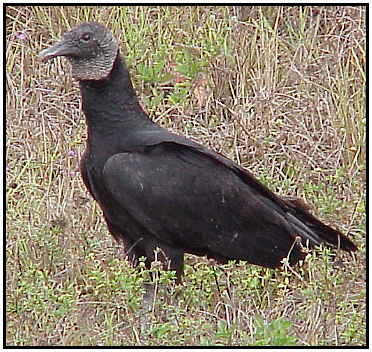
 VULTURES are quite common in our area, but usually in more rural parts. Imagine, then, our surprise when we saw one feasting on a delicious dead animal on a lawn not six feet from the road in a quiet neighborhood just behind the school. We stopped to snap a picture but the bird got spooked and flew onto the roof. Then we saw the others - a total of four waiting in a tree for us to leave so they could finish their lunch. In flight turkey vultures and black vultures are easy to distinguish from one another - turkey vultures have white wing tips and white feathers along the back of their wings; black vultures have white only on their wing tips. Up close, the grey heads (not red) gave these away as black vultures. Beauty could not be seen in the eyes of this carload of beholders; however we did appreciate the cleanup work they were doing. I bet the homeowner did too.
Thursday, September 27, 2012
Hungry as Vultures
VULTURES are quite common in our area, but usually in more rural parts. Imagine, then, our surprise when we saw one feasting on a delicious dead animal on a lawn not six feet from the road in a quiet neighborhood just behind the school. We stopped to snap a picture but the bird got spooked and flew onto the roof. Then we saw the others - a total of four waiting in a tree for us to leave so they could finish their lunch. In flight turkey vultures and black vultures are easy to distinguish from one another - turkey vultures have white wing tips and white feathers along the back of their wings; black vultures have white only on their wing tips. Up close, the grey heads (not red) gave these away as black vultures. Beauty could not be seen in the eyes of this carload of beholders; however we did appreciate the cleanup work they were doing. I bet the homeowner did too.
Saturday, April 7, 2012
Fossil Hunting

 WHAT a treat to be taken fossil hunting by a friend's dad. The children had the best time digging around in the earth with old screwdrivers, and were delighted when they found impressions of plants and animals. Millions of years ago, this area in North Georgia was covered in swamp. Dead animals and plants fell into the water and were covered by many layers of mud, which eventually hardened into shale. In between these layers, hidden treasures wait to be discovered. We found brachiopods and crinoid stems. Crinoids are sea animals which resemble today's sea lilies. Brachiopods appear similar to today's bivalves such as clams, but researchers believe they are a distinctly separate group. Not quite as exciting as dinosaur bones, but almost.
 Tuesday, March 20, 2012
First Day of Spring... or Summer?

Saturday, October 8, 2011
Flower Shapes

I love to look at shapes in nature. This one.. Indian Heliotrope or Turnsole (heliotropium indicum) I believe... doesn't it remind you of an octopus' tentacle?
Heart-shaped, bell-shaped, metaphor of form.
Is it symmetry or silhouette,
A reminder of shapes of the past,
Connection, categorization,
Or simply individual expression of beauty?
Friday, September 23, 2011
Cool but Clunky

THE children have discovered in our garden what they have dubbed "the coolest bug ever". It's a wheel bug. He caught our attention noisily flying around our back patio and we transferred him to a bug box with a magnifying lid to examine in closer detail. These creatures are often called "assassins of the insect world" thanks to their chosen method of feeding, which involves using their long beak to pierce soft-bodied insects like caterpillars with dissolving enzymes, then sucking out their insides. How charming. Sometimes the females even feed on the male after mating. The cannibalism was not a trait I shared in detail with the children, but we did observe that it moves very slowly and jerkily and has of course that huge and strange "bumpy hump" on its back. Big, clunky, and indeed pretty cool.
Herbal Frogspawn

Thursday, September 22, 2011

Sunday, September 11, 2011
The Most Amazing Thing
 THE other day we noticed a green caterpillar on one of the tomato plants. Having plucked it off ready to deposit elsewhere, we realised that the tomato plant was nearly dead anyway so the caterpillar might as well enjoy the last few leaves. So we put it back. Imagine our surprise when the next day we found it tucked cosily in a cocoon! In fact there were two of them! Two days later the plant was indeed dead, as was apparently the second pupa. But the first pupa still wiggled when gently prodded, and one part had turned brown inside its opaque, silky home.
On my return from a trip four days later, Emma greeted me with: "Mama! The most amazing thing happened!" It seemed that the pupa had transformed into a moth, which Emma had discovered drying its wings next to the empty cocoon. It had flown away by the time I got home, so we didn't get to photograph or identify the moth or butterfly, but it could have been a diamondback moth.
Pupa, Chrysalis or Cocoon?
A pupa is an insect undergoing transformation. If it is a butterfly pupa, it is called a chrysalis and is surrounded by a hard casing. Moth pupas most often change inside a cocoon of spun silk, though some species burrow into the ground. Pupas of other insects change inside the exoskeleton of their final larval stage, or in a nest or shell.
Sunday, September 4, 2011
Creek Life
YOU'D think with four children under six, a mad labrador and an excitable Jamaican in our camping party, the wildlife would stay very, very far away. And indeed many of the wiser creatures did, a few cawing a retreat or leaving a tiny footprint behind. But not all. Whether oblivious, confined or simply unperturbed, some animals of the water allowed themselves to be discovered.
Armed with new birthday catching nets and bug boxes we went to explore the creek. It was bursting with animal life! Diving beetles tootled leisurely through the water as pond skaters gathered in little groups around the edges. Tiny fish came into sight when we stayed very still then flitted away the second a small foot disturbed the silt. A 10cm long stick insect brushed my nose as I ducked under an overhanging branch. Two crawfish were enjoying a little sunlight in a shallow, sandy spot and dragonflies flew abundantly overhead.
But it was one particular insect that caught my attention. Under almost every stone we found the same clear-coloured crawling creature with a split tail from a few millimetres to 2cm or so, including a couple of larger outgrown skins outside the water. I think they were mayfly nymphs. Mayflies live up to a year under water in the larval stage, then crawl out of the water and in their last stages of moulting, emerge with wings. They then fly around for one day only, during which time they mate and lay eggs on the water's surface, where they sink to the bottom to repeat the cycle. Whatever they were, they made interesting creatures to watch.
Armed with new birthday catching nets and bug boxes we went to explore the creek. It was bursting with animal life! Diving beetles tootled leisurely through the water as pond skaters gathered in little groups around the edges. Tiny fish came into sight when we stayed very still then flitted away the second a small foot disturbed the silt. A 10cm long stick insect brushed my nose as I ducked under an overhanging branch. Two crawfish were enjoying a little sunlight in a shallow, sandy spot and dragonflies flew abundantly overhead.
But it was one particular insect that caught my attention. Under almost every stone we found the same clear-coloured crawling creature with a split tail from a few millimetres to 2cm or so, including a couple of larger outgrown skins outside the water. I think they were mayfly nymphs. Mayflies live up to a year under water in the larval stage, then crawl out of the water and in their last stages of moulting, emerge with wings. They then fly around for one day only, during which time they mate and lay eggs on the water's surface, where they sink to the bottom to repeat the cycle. Whatever they were, they made interesting creatures to watch.
Wednesday, August 31, 2011
It's a Record!
 WHILE walking home from school one day, we noticed a proliferation of one type of insect on the grass under a particular maple tree. Looking somewhat like a firefly, we took note of its markings and looked it up at home. It was a box elder bug, a true bug which feeds predominantly on box elder trees and also maples.
We've since seen this bug many times, always under maples. They are not especially fast moving, which makes them attractive to Alexander. Every time we see them he tries to outmatch his own record of how many he can hold in his hand at any one time without any flying away or being squashed. I try to share his joy while secretly encouraging escape.
Despite the occasional mishaps, the bug does now have the honour of having renamed this route home from school. It is now called "Box Elder Way".
Monday, August 29, 2011
Birthday Butterflies
 LOOKING back through old posts, I'm reminded that Emma received a "bug hotel" for her third birthday. Now rather the worse for three years of weather, it has nevertheless provided much interest to us and a home for many insects.
I'm not sure if it's coincidence that one of Alexander's favourite presents on his third birthday was a butterfly net and bug collection box! He has spent hours outside trying to - often successfully - catch various insects, which he then stores in his special jar with a magnifying lid. Happy birthday little bug catcher!
Thursday, August 25, 2011
The Next Plague?
 LAST year we noticed a great number of insects we hadn't seen before in the park. Little green/brown bugs, they looked a little like ladybirds but had a distinct triangular shape, the head much narrower than the tail end. They congregated in great numbers on the kudzu, were easy to pick up, flew away just as easily and didn't smell too good when squashed (accidently). It was Megacopta cribraria, otherwise known as the "kudzu beetle".
Alexander was delighted to discover them today in our garden too, on wisteria, which prompted me to research them. This little bug was first seen in the US, or in the Western hemisphere at all, in October 2009. It was discovered right here in nine counties in north Georgia and in a year had spread to over 60 counties. Now Megacopta is also a resident of North Carolina and South Carolina. The rapid spread is particularly worrisome to agriculture, since the bugs are voracious eaters not only of kudzu (which grows equally fast and does not seem to be unduly damaged by the pest) but other legumes too - especially soy beans.
Soy being, in my opinion, one of the most heinous of all crops in terms of contribution to the proliferation of cheap processed "foods", I had a fleeting thought that this little beetle army might be on a divine mission to save us from ourselves...
Tuesday, August 23, 2011
Preserving Herbs
 IT'S funny what things we take for granted that children know. A few weeks ago Emma and Alexander helped me harvest mint, rosemary, oregano, thyme, basil and Thai basil in our garden then bundle them and hang them up to dry. Today we were preparing old glass shop-bought herb jars to store them when Emma suddenly looked at me with a mixture of astonishment and revelation: "Mama, you mean herbs in the garden are the same thing as herbs in jars?"
Monday, August 22, 2011
Black Walnut Adventures
 I was recently introduced to the Eastern Black Walnut tree juglans nigra through its fruit, which hung heavy and green, like smooth golf balls. Parts of last year's crop that the squirrels had spared lay dried in the grass, but the fresh new fruit smelled fresh, almost citrusy. Evan, the tree owner, advised that the nuts are very difficult to open. He may as well have thrown down a glove.
Back home the children and I tried to crack it. The husk came off relatively easy with a knife. Immediately the flesh began to oxidise and turn brown. After rendering inoperable a heavy-duty and formerly rather nice nutcracker, we conceded that black walnuts are, in fact, rather hard to open. We also noticed that my hands were turning various shades of yellow to dark brown and black, as was the counter top, and ... it didn't come off. Emma wondered if this is why it's called black walnut. We took the stubborn nut outside and pretended we were hunter-gatherers, smashing our dinner open with a rock. Success! Tasty, but hard-earned. No wonder they are so expensive to buy.
Having already discovered the dyeing properties, we then decided to dye something for real. Using a piece of white cotton fabric, the result was an earthy dark brown. Not a colour en vogue this year, but it would be perfect for camo gear. Thank you Evan for inspiring an afternoon of fun and discovery!
Saturday, August 20, 2011
Twilight Magic
 TWILIGHT is one of the most magical times to be outside. To observe the sun inch lower and lower with perceptible movement brings a sense of oneness with time. We have been taught of the earth's rotation around the sun, yet to many these are mere words; whereas experiencing a sunset (or sunrise) forges a deep inner connection to this cosmic reality. Images of the sun going to bed are not just for children; experiencing the dusk is to remember the beauty of the day, breathe out and prepare for rest.
Animals too favour the beginning and end of the day. As I sat with a new group of friends with the magnificent backdrop of the setting sun, for a short while the trees came alive with birdsong. It gradually darkened and the evening grew still. Then, a deer gingerly stepped out of the bushes followed by another. As we continued our gathering, the does moved closer browsing in the long grass for shoots and fallen fruit. Their babies followed and the usually shy animals munched away, stopping now and again to nurse or bleat a message to one another. I was entranced. For this special time between day and night, deer and people shared time and space.
Photo credit: http://www.woodlandmarketingmanagement.com/
Wednesday, August 10, 2011
The Lorelei Calls
 HAPPY sixth birthday Emma! We had great fun preparing for her mermaid party - designing a menu, painting underwatery paintings to hang up, planning activities and decorating with strips of blue and purple crepe paper, which waved delightfully when the ceiling fan was turned on.
On the big day, it was hard to contain their excitement. Six little girls and one little brother made shell necklaces, played musical mermaid rocks then sat on their rocks for a tea of seaweed, kale chips, tuna crackers and "rainbow fish" cake. Outside, water beads awaited discovery in the paddling pool,
 and finally a treasure hunt for a take-home mini treasure chest of sparkling gems. The theme continued until her actual birthday two days later when Emma received her present from Mama - a beautiful mermaid of her own!
Sunday, July 31, 2011
Naked Tree Climbing
 ALEXANDER was having some fun running away from his bath. Up a tree was an excellent place to hide.
While there he noticed the dogwood berries just beginning to form and was quite intrigued about what might eat them. Not content with "squirrels and birds", he wanted to know what kinds of birds. I said we'd have to wait until they are ripe and watch to find out. He wanted to wait there until they were ripe but looked like he just might reconsider when I said he'd have to sleep in the tree for many nights. A warm bath did sound preferable, after all.
Tuesday, July 26, 2011
Grrr! said the Tiger
 WE tried for ages to identify this interesting fly we found on our window screen. It was on something white and we couldn't tell if it was feeding on bird droppings or if it was some kind of nest/egg collection. Whatever the white patch was, the fly was quite attached to it. We picked the fly up to examine it, and it flew away, then a short time later was back again and even returned the next day.
It was quite large - maybe 2cm. Plump and black, with a fuzzy body, huge eyes and a curious pattern on its wings. We couldn't tell if the wings had patches of white or patches of see through.
Finally a few days later we found a picture of the tiger bee fly Xenox tigrinus . Emma astutely pointed out that tigers have stripes not spots and why wasn't it called a leopard bee fly? Apparently they lay their eggs in the nests of carpenter bees and their hatching larvae then eat the bee larvae. The white stuff on the window screen wasn't eggs, then.
Tuesday, July 19, 2011
Not Playing Possum
 AN unexpected encounter greeted us recently at the woods - one who was not playing possum. Instead of playing dead like this animal is wont to do when threatened, this possum was very much alive and snarling. A shuddering lady was trying unsuccessfully to release it from a trap she had laid in her garden. Its strong fingers and sharp nails clutched fast to the wire cage as she tried to gently shake it loose. Alexander's eyes grew wide as the scared creature hissed and bared its extremely ferocious looking teeth. With the aid of leather gloves and a stick, the lady and I managed to pry its feet loose and the possum backed out of the cage into its new habitat. Needless to say the encounter with "the animal with the triangle mouth and lots of teeth" has been the talk of the week.
Thursday, July 7, 2011
Summer Breakfast
 ONE of the best things about school holidays is that there's no rush in the morning! That means there's plenty of time to prepare a breakfast feast. One morning Emma fancied fruit salad "with all the fixin's" and, oblivious to the fact that it was still dark, set to work preparing it, her sous-chef by her side.
 Unable to contain my curiosity any longer, I peeked into the kitchen and was crossly dispatched back to my bedroom. It was worth the wait.
A delightful healthy breakfast, beautifully presented and prepared with pride by an almost-6 and almost-3 year old, awaited the family on the dining table.
Subscribe to:
Posts (Atom)
